

Train the Trainer (TTT)
How I standardized training delivery at scale — reducing variation and accelerating facilitator readiness across 3 manufacturing lines.
OVERVIEW
Operators were being trained by different leads, using different styles — which meant training quality depended entirely on who was teaching. In regulated manufacturing, variation = defects.
I built and piloted a Train-the-Trainer (TTT) program to eliminate variation at the source. I used ADDIE and Microsoft Copilot to rapidly analyze qualitative feedback, design the facilitation model, and accelerate content build.
Impact:
- reduced clarifying questions on the floor after training
- increased facilitator confidence + consistency (as reported by supervisors)
- accelerated content creation (Copilot cut initial build time from days → hours)
MY ROLE
Lead Instructional Designer — owned analysis → design → evaluation
THE BUSINESS PROBLEM
Training outcomes were inconsistent because there was no standard for how training was delivered. Some leads were natural teachers. Some weren’t.
This inconsistency created unnecessary variation and slowed time-to-competency.
WHAT I DID?
1) Analysis
- Interviewed SMEs + leads across 3 critical lines
- Utilized Copilot to synthesize survey comments to identify themes
- Benchmarked against compliance expectations
2) Design
- Created a facilitation model + participation framework
- Built scenario prompts and assessments (RBA style)
- Aligned learning objectives to adult learning principles
3) Development
- Facilitator guides
- Slide decks
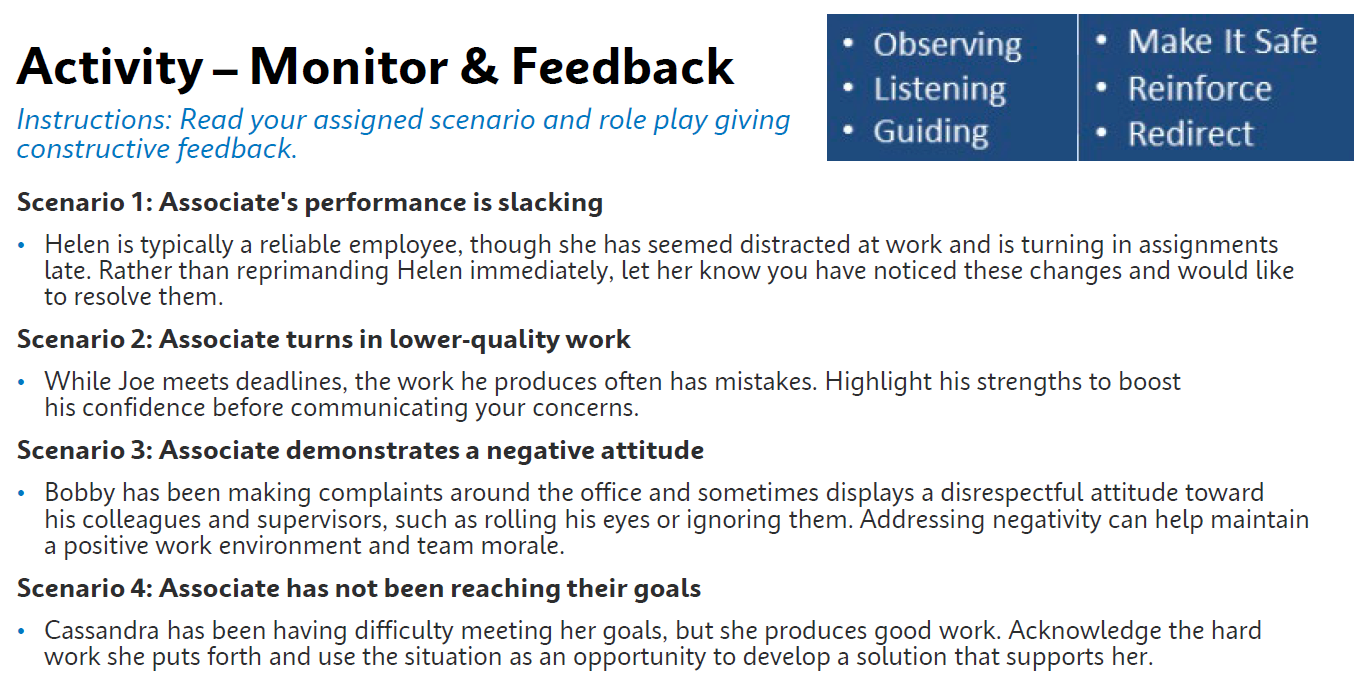
- Designed and implemented live, scenario-based simulation exercises with a hands-on approach. See the following example below.
4) Pilot implementation
- Delivered a blended TTT with 14 lead trainers
- Mixed live + virtual to cover multiple shifts & locations
5) Evaluation
- Utilized Microsoft Co-pilot to surface patterns in open-ended pilot feedback
- Iterated content based on most common friction points
WHAT CHANGED (RESULT)
Supervisors reported fewer clarifying interventions after the pilot. Trainers were delivering in a more uniform structure, and learners described sessions as more “clear and organized.”.
What was even more important: Manufacturing Leads said they finally felt like facilitators, and not just tribal knowledge holders.
Based on their feedback, time-to-time competency on the floor decreased by an estimated 20-30%.
